Address
86 Amesbury Road
Manchester M9 6JF United Kingdom
Caravan levelling ramps vs chocks explained simply - what each does, when to use them, and how to choose the right setup for safer pitching.
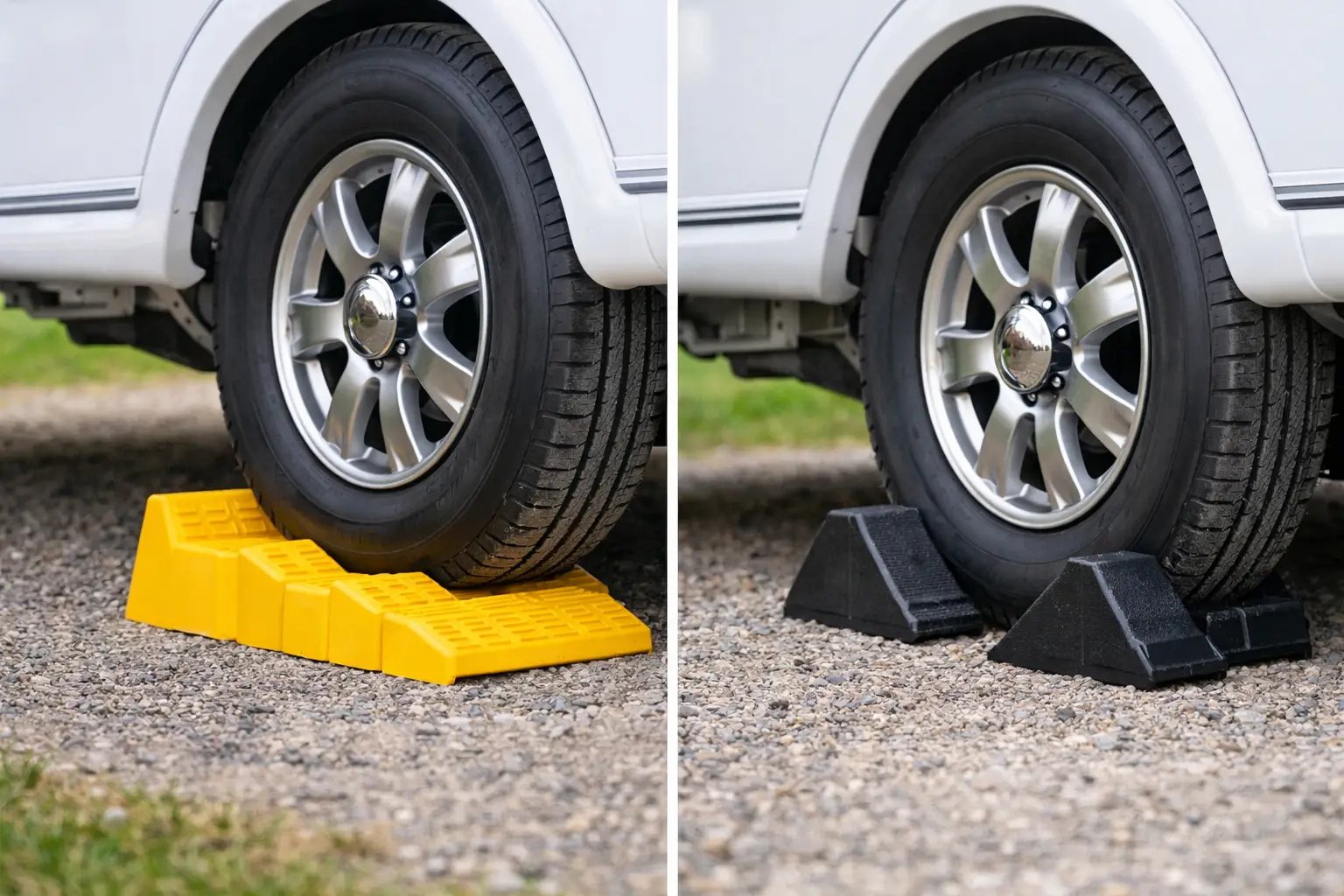
Pull onto a pitch, step inside, and the whole caravan feels slightly off. The kettle leans, cupboard doors swing, and sleeping comfortably suddenly looks less likely. That is where caravan levelling ramps vs chocks becomes more than a small gear question – it is about stability, safety and making setup quicker from the start.
A lot of caravan owners treat ramps and chocks as if they do the same job. They do not. They work together, but they solve different problems. If you know what each one is for, it is much easier to buy the right kit, avoid frustration on site, and get your caravan settled properly without trial and error.
Levelling ramps are designed to raise one side of the caravan so it sits level from side to side. If the pitch slopes left or right, you place a ramp in front of or behind the wheel on the lower side and move the caravan onto it. That extra height helps correct the tilt.
Chocks are there to stop the wheel from rolling once the caravan is in position. They are a safety item, not a levelling tool. After the caravan is on the ramp and where you want it, the chock goes snug against the wheel to help prevent movement.
So the short version is simple. Ramps lift. Chocks stop rolling. If you use one and ignore the other, you are only doing half the job.
It is easy to see why this happens. Both sit near the wheels. Both are used during setup. Both are small bits of kit that tend to live in the same locker. But in practice, swapping one for the other does not work well.
A chock is not shaped to lift a caravan enough to level it properly. It may add a tiny bit of height, but not in a controlled or reliable way. A ramp, on the other hand, is not always enough on its own to stop movement once you have finished positioning. On a firm, flat pitch you might feel fine for a moment, but proper wheel security still matters.
For most caravanners, this is not an either-or choice. It is more often a question of which ramp suits your caravan and pitch habits, and which chocks are easiest to use alongside them.
If you mostly use well-kept touring parks, you may not need much correction on every trip. Even then, a slight slope can make everyday use annoying. Fridges can perform less efficiently if the caravan is not level enough, and washing up on a wonky worktop gets old very quickly.
Levelling ramps become especially useful on grass pitches, older sites, temporary stopovers, or anywhere the ground is uneven. They are also handy if one wheel naturally settles lower on softer ground. In those situations, trying to manage without ramps can turn a straightforward arrival into a lot of shuffling back and forth.
The key is choosing a ramp with enough height and grip for your setup. A lightweight single-axle caravan on a mild slope may only need a basic ramp. A twin-axle caravan, or a pitch with more of a lean, may need something stronger or more purpose-built.
Some ramps have stepped levels, which make it easier to stop at a set height. Others have a curved design that gives more gradual adjustment. Neither is automatically better for everyone.
Stepped ramps can be simpler for newer caravanners because you can feel where the wheel settles. Curved ramps can offer finer adjustment, but some people find them slightly trickier until they get used to them. Grip, width and build quality matter just as much as the shape. If the ramp slips on wet grass or feels too narrow for confidence, setup becomes harder than it needs to be.
Chocks earn their keep once the caravan is where it needs to be. After levelling side to side and before fully settling in, you want the wheel held securely. This is particularly important on sloping pitches, in wet conditions, or when there is any chance of movement during hitching, unhitching or general setup.
Good chocks are compact, straightforward and quick to place. You do not need anything overcomplicated, but you do want something solid enough to stay put under pressure. A flimsy chock can shift, especially if the surface is loose gravel or damp grass.
For many owners, chocks are one of those items that seem unremarkable until the day they are badly needed. They are not glamorous, but they are part of a sensible, stress-saving setup.
In reality, you will probably carry both and use them as needed. On some pitches, the caravan may already be close to level and the ramp barely needed, if at all. The chock can still be useful for securing the wheel. On other pitches, the ramp will do a lot of the work and the chock will finish the job.
If you only buy one item, ramps might feel like the more obvious choice because you notice the comfort difference straight away. But from a safety point of view, chocks still deserve a place in your kit. They are inexpensive, easy to store and useful far beyond the perfect-weather, perfectly-flat pitch.
That is why the better comparison is not really caravan levelling ramps vs chocks as competitors. It is ramps for levelling, chocks for stability, and both for a smoother arrival.
Start with your caravan type and the kind of sites you actually use. If you tour mainly on level hardstanding, you may not need the tallest or heaviest ramps on the market. If you regularly stop on mixed surfaces or less predictable pitches, a sturdier ramp with decent traction is worth having.
Think about wheel size and load as well. The ramp needs to suit the weight it is carrying. It should also be wide enough to feel secure when manoeuvring onto it. If using a motor mover, smooth control becomes even more important, so a stable, well-made ramp helps.
For chocks, the main question is practicality. Will they sit firmly against the tyre? Are they easy to place and remove? Can you store them without fuss? This is everyday kit, so convenience matters. EasyPeasyMate.Shop’s kind of no-fuss caravan essentials appeal for exactly this reason – simple gear that does the job properly without turning setup into a chore.
Most modern ramps and chocks are made from heavy-duty plastic, which keeps weight down and resists weather well. That is ideal for most people, but not all plastics are equal. If the product feels brittle or overly light for its size, it may not inspire much confidence over time.
Look for a design that feels stable, has sensible grip, and can cope with repeated use. Caravan kit gets dragged across gravel, damp grass and storage lockers. Durability is not about having the fanciest product. It is about buying something that keeps life easy trip after trip.
One of the biggest mistakes is trying to level front to back with side ramps alone. Side-to-side levelling with ramps comes first, then front-to-back levelling is adjusted with the jockey wheel. Mixing those steps often leads to more repositioning than necessary.
Another common issue is forgetting the surface itself. Even a good ramp can struggle on mud, loose gravel or very slick grass. In poor conditions, take extra care and check that the ramp is seated properly before moving onto it.
People also sometimes rely on the corner steadies to compensate for poor levelling. They are there to steady the caravan, not to lift it into level. Using them that way can cause problems and does not solve the original issue.
Finally, do not rush the last step. Once level, secure the wheel properly with a chock if needed, then check stability before settling in. A few extra seconds here can save a lot of annoyance later.
If the question is which one changes the comfort of your stay most, levelling ramps probably win. They fix the obvious problem of a caravan sitting unevenly, and you feel the difference as soon as you step inside.
If the question is which one helps with wheel security, chocks are the proper answer. They are there to reduce unwanted movement and support safe setup.
So which is better depends on what you are asking them to do. For levelling, choose ramps. For stopping roll, choose chocks. For a tidy, practical pitching routine, keep both in the locker and use each for its proper job.
A well-set caravan always feels easier to live with. Get the basics right at the wheel, and the rest of the trip tends to fall into place.
