Address
86 Amesbury Road
Manchester M9 6JF United Kingdom
Looking for clothes airer alternatives? Compare practical indoor and outdoor drying options for compact homes, rainy days and busy daily laundry routines.
A full clothes airer can take over a kitchen, spare room or landing for days, especially when the weather refuses to cooperate. The good news is that clothes airer alternatives can free up floor space, speed up laundry day and make drying feel far less like a household obstacle course.
The right option depends on your home, the size of each wash load and whether you need something permanent or easy to put away. Some choices are ideal for a small flat, while others suit busy family homes with towels, school uniforms and bedding on repeat.
A heated airer looks familiar, but it changes the drying process considerably. Its gently warmed bars help clothes dry faster than on a standard rack, particularly in colder months when indoor air is cool and damp. Many come with a fitted cover, which holds warm air around the laundry and gives you a more contained drying space.
It is a practical choice for regular indoor drying, but it still needs floor room and uses electricity. Check the running cost against how often you wash, and avoid overloading it with thick items that block airflow. For households doing several smaller loads each week, it can be more useful than waiting for one huge laundry pile.
If your main problem is losing valuable floor space, a wall-mounted rack is one of the smartest clothes airer alternatives. These racks fold flat against the wall when not in use, then pull out to provide rails for lightweight clothing, tea towels or a small wash load.
A utility room, bathroom, kitchen wall or sheltered porch can work well. Choose a solid wall and make sure the fixings are suitable for the weight of wet washing. It is not the best answer for king-size bedding, but for everyday tops, socks and children’s clothes, it keeps laundry neatly out of the way.
Ceiling airers, often called drying pulleys, make excellent use of space that is normally ignored. The rack is lowered to load washing, then raised towards the ceiling where warmer air naturally collects. This can be particularly handy in homes with high ceilings, utility rooms or a well-ventilated kitchen.
The main advantage is simple: your laundry is up, not under your feet. Installation takes more planning than buying a folding rack, and it needs to be securely fitted to suitable joists or supports. Once in place, though, it offers a tidy long-term solution with plenty of capacity.
For a quick, low-cost fix, an over-door airer is useful for small items and emergency drying. It hooks over an internal door and can be folded away when you need the room clear. It is well suited to underwear, baby clothes, sports kit or a handful of lightweight garments.
Radiator airers work in a similar way, but use them with care. Keeping fabric directly against a hot radiator can restrict heat circulation and may create damp patches around a cold wall. They are best for a few small pieces rather than a full wash load. Never place items on electric heaters, and keep laundry clear of portable heaters and open flames.
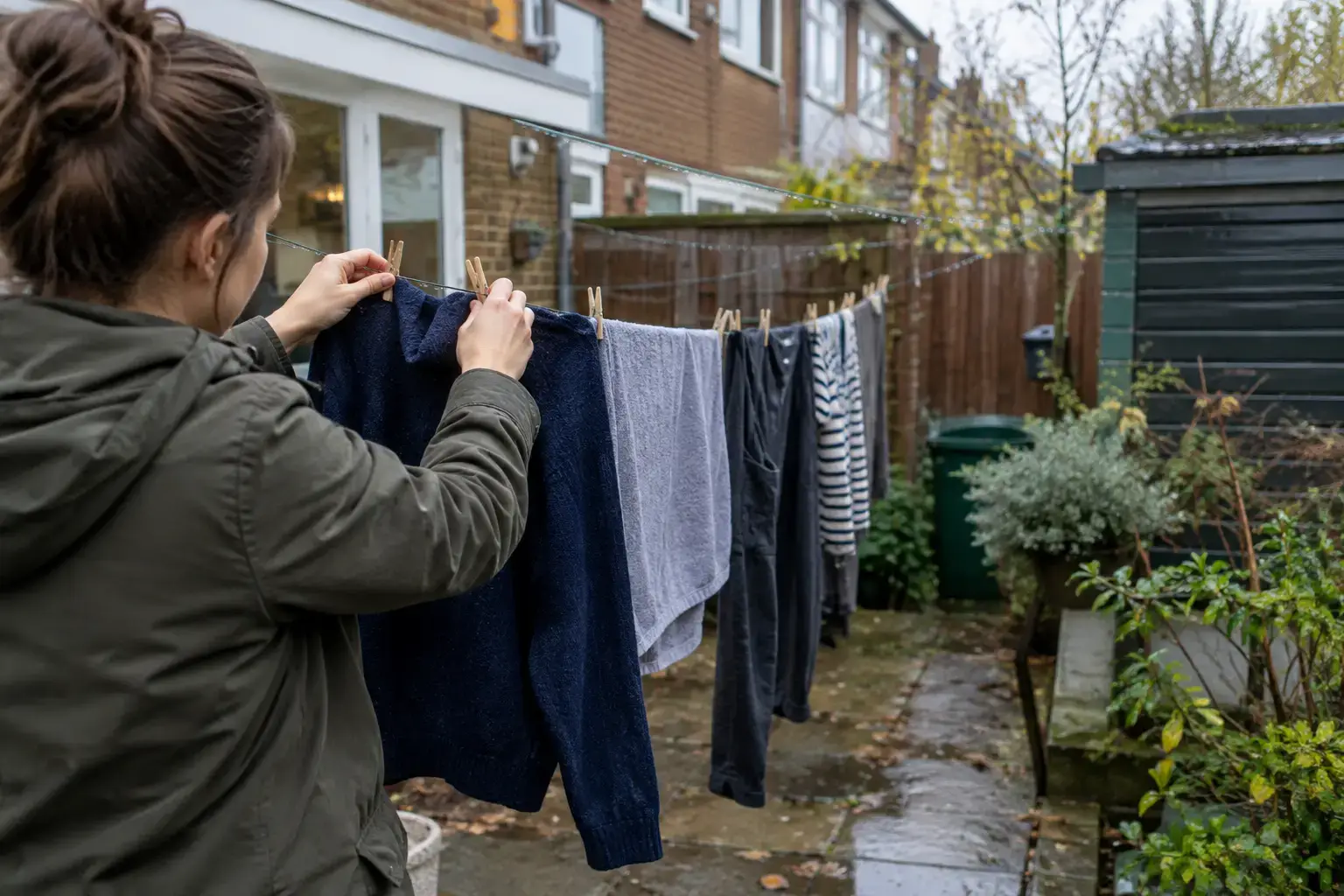
When it is dry outside, fresh air and a breeze remain hard to beat. A rotary washing line holds a large load without taking up much garden space, and it folds down when not needed. It is especially useful for sheets, duvet covers and towels that would otherwise crowd an indoor room.
British weather means you will not use it every day, but it is still one of the most economical ways to dry washing. Put it where there is good airflow and as much sun as possible, away from overhanging trees where pollen, leaves and bird droppings can cause extra work. A weatherproof cover helps keep it clean between uses.
A retractable line is a neat option for smaller gardens, patios, balconies and utility areas. The line pulls out from a wall-mounted housing and clips to an opposite post or fixing point, then retracts when the washing is dry. It is much less visually intrusive than a permanent line and leaves outdoor space clear for children, pets or a garden chair once laundry day is done.
Before fitting one, measure the span and check that both anchor points are strong enough. A line stretched too far or loaded heavily with wet towels will sag. Several shorter lines can be easier to manage than one long line, giving garments more space for air to move around them.
For speed and convenience, a tumble dryer is the obvious alternative to an airer. It is particularly helpful for large households, rainy spells, work uniforms and bulky towels. Heat-pump models generally use less energy than traditional vented or condenser dryers, although they can take longer to run and cost more upfront.
Not every fabric belongs in a dryer. Check care labels for delicate items, wool, printed garments and anything prone to shrinking. A washer dryer can be useful where space is tight, but drying capacity is often lower than wash capacity, so you may need to remove part of the load before switching cycles. It is convenient, not always the quickest route through a mountain of laundry.
Even the best drying solution will struggle in a cold, closed room. Good airflow matters more than people think. Leave gaps between garments, turn thick items halfway through drying and avoid draping everything in layers. If possible, dry laundry in one room rather than spreading damp washing around the house.
Ventilation also helps reduce condensation. Open a window briefly when conditions allow, use an extractor fan in a utility room or bathroom, or run a dehumidifier nearby. A dehumidifier can collect moisture from the air while helping clothes dry faster, which is useful in winter or in homes prone to condensation. Keep it on a stable surface and follow the manufacturer’s guidance for room size and placement.
Try to wash little and often if your household allows it. A smaller load is easier to hang with space around each item, and it will usually dry faster than an overloaded rack. Give heavier pieces such as jeans, hoodies and towels first choice of the warmest, airiest spot.
Start with the space you actually have, not the space you wish you had. Renters may prefer freestanding heated airers, over-door racks or a retractable line that can be fitted with permission. Homeowners with a utility room might get more value from a wall-mounted rack or ceiling pulley that becomes part of the room.
Think about laundry volume too. A single person may only need an over-door rail and an outdoor line for bigger items, while a family with children will benefit from a high-capacity airer, dryer or rotary line. If bedding is your biggest drying headache, look for wide rails, outdoor capacity or a dryer with a suitable programme.
Finally, consider running costs alongside convenience. Outdoor lines cost nothing to use, wall and ceiling racks need no electricity, and heated options can reduce drying time without committing to a full tumble-dryer cycle. There is no one perfect answer – often the easiest setup is a mix of two options for different weather and wash loads.
A small change can make laundry feel much more manageable: keep everyday clothes moving indoors, save the garden line for larger loads, and give each item enough air to dry properly. That is less clutter, fewer damp towels and one more household job made easy peasy.
