Address
86 Amesbury Road
Manchester M9 6JF United Kingdom
A heated clothes airer review covering drying times, running costs, capacity and safety, helping you choose a practical indoor dryer for your home too.
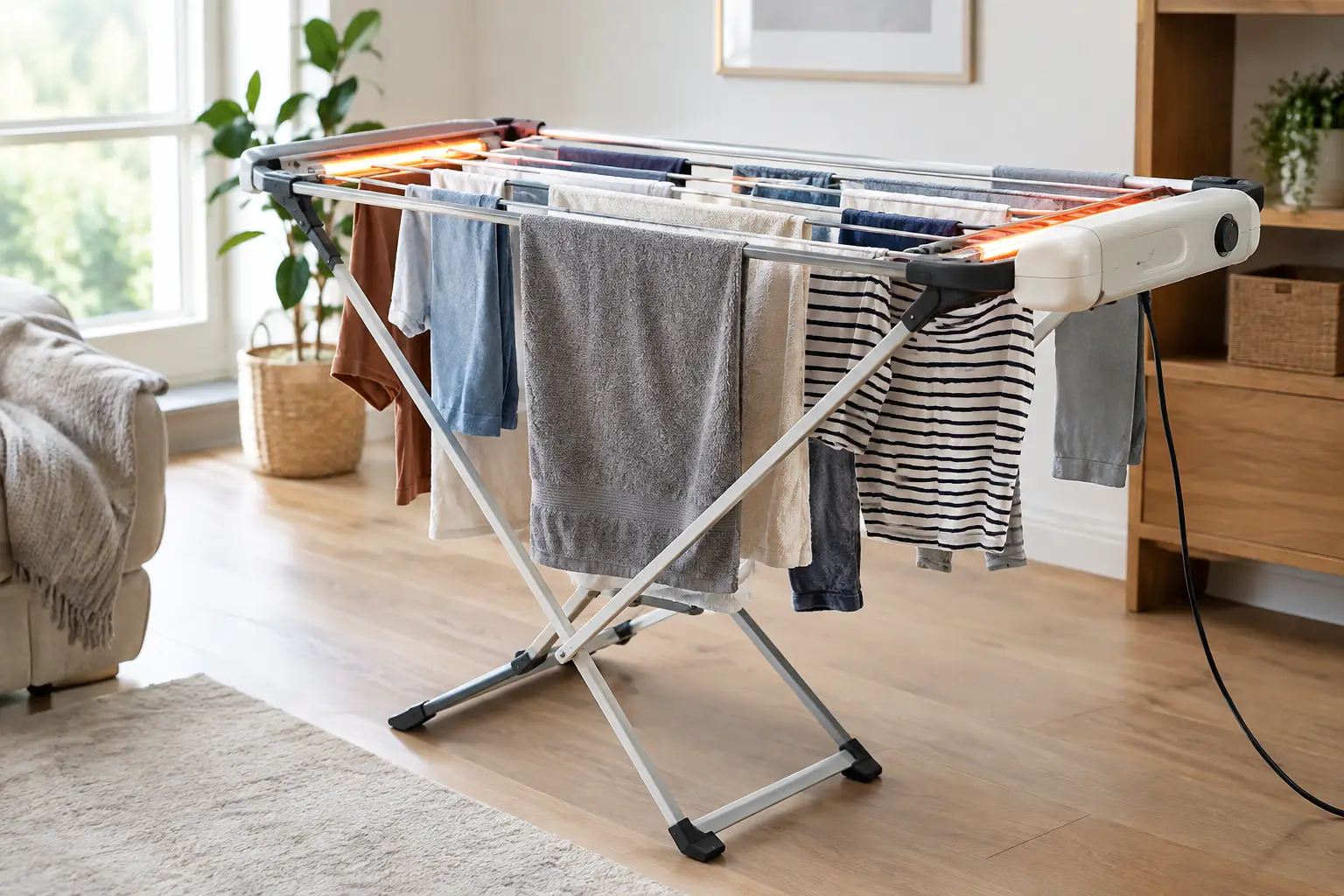
A wet wash load draped over radiators can make the whole house feel cluttered, while a tumble dryer may feel like an expensive habit during a busy week. That is where a heated clothes airer review can be useful. These plug-in drying racks promise a simpler middle ground: gentler than a tumble dryer, quicker than an ordinary airer and easy to use in a flat, family home or utility room.
The short answer is that a heated airer can be well worth buying, but only if it suits the way you do laundry. It is not a magic cupboard that dries a full load in an hour. Think of it as a low-heat drying rack that works best with sensible loading, decent airflow and, ideally, a cover.
A heated clothes airer looks much like a folding indoor drying rack, except its rails warm up when connected to the mains. The heat encourages moisture to leave clothes more quickly than it would on an unheated rack. Most are designed to use far less power than a tumble dryer, making them appealing for regular small and medium loads.
However, the rails are warm rather than hot. A thick towel or a pair of heavy jeans will not dry at tumble-dryer speed, particularly in a cold room. Drying time depends on fabric, spin speed, how closely items are packed and the humidity in the room. For everyday tops, school uniform, socks and underwear, the improvement can feel very noticeable.
A covered model usually gives the best result. The zip-up cover traps a pocket of warm air around the clothes, helping them dry more evenly and keeping dust off. It also creates a tidier look in a living area. An open-wing airer is often more flexible for shirts, bedding and longer items, but it relies more heavily on room ventilation.
The biggest benefit is control. You can dry a few essentials overnight or deal with a midweek wash without filling every radiator in the house. Clothes dry with less tumbling and agitation than in a dryer, which can be kinder to delicate fabrics, printed garments and anything prone to shrinking.
They are also easy to store. Most fold down when not needed, so they make sense for smaller homes where a permanent drying solution is not realistic. For households doing frequent washing – parents, sports families or anyone managing work uniforms – that convenience soon adds up.
The catch is capacity. Marketing photos can make an airer look ready for a mountain of laundry, but overloading is the fastest way to slow it down. If every rail is covered by thick, overlapping fabric, warm air cannot circulate properly. A heated airer is at its best when you treat it as a carefully arranged drying space rather than a place to pile on an entire overflowing basket.
It may not replace a tumble dryer for every household. Large families who regularly wash towels, bedding and several full loads a day may still want a dryer for the heaviest jobs. But for people who want to reduce dryer use, avoid damp washing hanging around for days or dry clothes without using radiators, it is a genuinely practical bit of kit.
A heated airer is generally inexpensive to run compared with a tumble dryer, but the actual cost comes down to its wattage, your electricity tariff and how long it is switched on.
The simple calculation is:
Wattage ÷ 1,000 × hours used × your unit price = estimated cost
For example, a 300W airer uses 0.3kWh each hour. If your electricity costs 30p per kWh, it works out at around 9p per hour. Run for six hours, that is roughly 54p. A 1,000W model will cost more than three times as much per hour, so it is always worth checking the product specification before buying.
Do not judge running cost on wattage alone, though. A lower-powered model that takes all day to dry a tightly packed load may not be the better buy. A well-designed covered airer can sometimes dry the same wash faster because it uses warmth more efficiently. Your laundry routine matters too. If you mainly dry a few shirts and children’s clothes, a compact model could be enough. If you wash bedding regularly, look for more rail space and a shape that accommodates larger items.
Start with where the airer will live when it is in use. Measure the floor space, but also consider height and room around it. You need enough space to load clothes comfortably and allow some airflow. A tall heated drying cabinet may hold plenty but can feel awkward in a compact flat. A winged airer takes up more width, while a tower-style model uses vertical space more efficiently.
A timer is one of the most useful features. It lets you set a drying session without leaving the airer running longer than necessary, which is good for both peace of mind and electricity use. A cover is another worthwhile extra, especially for winter laundry. Look for one that is easy to fit, has sensible ventilation and does not cling tightly to damp clothes.
Pay attention to rail layout as well as total drying length. Closely spaced rails are handy for socks and smaller items, but shirts and thicker fabrics need room. Some models include hanging sections or extendable wings, which can make day-to-day loading much easier.
Finally, check the folded dimensions and cable length. An airer that stores behind a door or beside a wardrobe is far more likely to become part of your routine than one that is awkward to move and nowhere to put away.
A heated airer works best after a good spin cycle. If your washing machine has a higher spin setting that is suitable for the fabric, use it. Removing more water in the machine is usually more effective than trying to dry dripping clothes with extra hours of heat.
Give items a shake before hanging them and leave gaps where you can. Put thicker fabrics on the warmest central rails or the areas recommended by the manufacturer, and place lighter items on the outer sections. Turn bulky items once during the drying cycle if they are still damp underneath.
Ventilation matters. It can seem counterintuitive to crack a window when you are trying to keep warm, but moisture needs somewhere to go. Even a slightly open window, extractor fan or dehumidifier can help reduce condensation and speed up drying. Avoid placing the airer right against a cold external wall, where moisture is more likely to settle.
If you use a cover, do not cram the airer until the cover is stretched tight. A little breathing room produces better results than a packed rack. This is also why two smaller drying sessions can be more effective than one enormous one.
Use a heated airer on a stable, level surface and plug it directly into a suitable wall socket where possible. Keep the cable tidy, especially in homes with young children or pets, and do not place the airer where it could be knocked into a bath, sink or other water source.
Follow the manufacturer’s instructions for maximum load, use of covers and recommended running time. Do not cover the control unit, trail clothing over plugs or use a damaged cable. Like any electrical household item, it should be switched off and unplugged before folding away or cleaning.
It is sensible to avoid leaving any electrical appliance operating when nobody is at home. If you want overnight drying, a timer and a clear, safe location make the routine more manageable. Check garments are dry before putting them in drawers too – storing slightly damp clothes can lead to that musty smell nobody wants.
A heated airer is a strong choice if you need a flexible indoor option for regular laundry, want to rely less on radiators or tumble drying, and have space for a folding rack. It is particularly handy through a British winter, when outdoor lines are less dependable and damp washing can quickly take over the house.
Choose a larger covered model if you often dry family loads and have room for it. Choose a compact version if you mainly need to rescue essential items, manage a smaller household or live in a flat. EasyPeasyMate shoppers looking for practical home solutions should focus on usable rail space, a timer and storage size rather than simply picking the cheapest option.
The best heated airer is the one that fits your laundry habits without becoming another awkward household chore. Give clothes room, use a good spin cycle and let the air circulate, and it can make wash day feel a good deal easier.
